Today's Trucking: Court action filed against interim HOS rule
A little recap, after a 15 year process the rules that restrict the number of hours a truck driver may work in a week were significantly revised for the first time in 2003. The original rule had been written in 1937, then slightly altered in 1962. Congress had mandated that the rules be changed, had given a list of factors that the Agency should consider (the rule-making process outlasted the ICC and the FHWA and eventually became the purview of the FMCSA), but did not say exactly what the rules should be.
Under the old and the new rules drivers were restricted to working 60 hours in a 7 day period, or 70 hours in an 8 day period.
However under the new rules if you take 34 consecutive hours off your hours are "reset" and you have a fresh 60/70 to work.
Also the rules restricted the number of hours you could drive in a "day" (after 1962 the rules were no longer tied to a 24 hour day). Under the old rules you could drive for no more than 10 hours before you took an 8 hour break. You can work and drive up to 16 hours before you have to take an 8 hour break, so your "day" could be anywhere from 18 to 26 hours long. Also you could "split break" and take your sleep break in installments, extending your day. Under the new rules once you start working you have 14 hours from the start of your day until you can drive no more. Also you are allowed 11 hours of driving time in a day.
Basically it's typical sausage making. There are plusses and minuses for safety and for the carriers. The upside from a safety perspective is there is a limit on the number of hours in a day you can go before you have to get off the road and there are 2 more hours of break every night. The downside is that you can drive one more hour a day and you can, in theory work more hours in a week (theoretically you can work 88 hours in an 8 day period with the 34 hour reset). From a productivity perspective the upside is you can possibly get more miles in a day with the extra driving hour. The downside is that any time that you are sitting counts against your 14 hour clock. So if it takes 6 hours to get the truck loaded at a grocery warehouse you only have 8 hours available to drive (and that assumes no other stops or breaks). Keeping the truck moving becomes very important to maximizing revenue. Routes were rearranged, extra trucks and drivers were acquired, and everyone adapted to the new rule.
So this rule goes into effect. Several groups sue, arguing that the rule does not consider the health of the driver, one of the factors Congress had insisted be taken into account. Eventually the rule is thrown out by the courts in July 2004. The FMCSA argues that they cannot rewrite the rules in the 90 days alloted by the courts, So Congress writes a provision into a transportation bill that freezes the rules for a year allowing the agency time to redo the rules. So in 2005, the agency publishes the revised new rule, which is pretty much the same as the 2003 rule (light trucks were given an even more lenient rule and the last vestiges of "split breaking" were eliminated). They are sued again. The rule is thrown out again in 2007. They petition for a stay allowing them time to redo the rule. They get a stay (only 90 days instead of the requested year) and produce another "new" rule, which is in every way the same as the old one (only with more text justifying the rationale followed). So now they have been sued again.
You would think at some point the agency would catch on that the courts do not approve of what they are trying to do. Also, one could make the point if Congress had just written a new rule in legislation they could have gotten exactly what they wanted and we wouldn't be tied up in court. Another issue is that Congress has been steadily exempting various industries in response to lobbying. For instance, propane delivery drivers are exempt from the rules (which is kinda odd given the hazardous nature of the load). Right now we have the worst of both worlds. Congress can dodge responsibility for the rules (and loudly complain that the agency isn't doing what they want without ever specifying what exactly they want) and industries are still getting preferential treatment by lobbying.
I think that the best hope for a good rule before 2010 or so would be via legislation. The Agency has gone nowhere fast over the past 4 years and doesn't seem to have any intent other than running out the clock. Of course given the election I suspect there will not be a lot of energy left to deal with this issue. So I suppose we will wait and eventually we will have a permanent rule. Hopefully we won't be waiting another 20 years.
Monday, December 31, 2007


Tuesday, December 25, 2007
Guilty Pleasures
Huckenfreude:
I admit to enjoying some Huckenfreude at the way the GOP establishment has come unhinged over Huckabee's rise. Listening to them reminds you of the liberal establishment going ape about Bush in '04 and '05 before they learned to pace themselves. Rush even took a break from popping pills and picking at his ingrown hairs to thunder forth that Mike Huckabee was liberal (which is what Rush calls anyone he doesn't like, even that guy with the Ron Paul button at Burger King that burned his triple whopper and gave him fries instead of rings). The Wall Street types were undecided whether to express alarm or contempt, so they just punted and displayed both.
The same folks who were the picture of tough minded paternalistic condescension to the Social cons when Rudy looked likely to win the thing going away "Look Paulie, I know he isn't everything you wanted, but times are tough now don'tcha see, and he's definitely better than that Hillary gal.", are now acting like they're in one of those Jim Cramer gone wild videos.
Even if I have ambiguous feelings about Huckabee I'm still enjoying seeing a man from "flyover country" make the Wall Street and Washington crowd sweat bullets.
Pleasure derived from the outrage of prominent conservative pundits over the rising poll numbers of Mike Huckabee. Particularly sharp when the pundits in question are partisans of Rudy Giuliani, but extends to supporters of Mitt Romney as well. Usually experienced by evangelicals, crunchy cons, populists, and other un-airbrushed elements of the conservative coalition. Tends to coexist with an awareness that Huckabee isn't actually ready for prime time, and that his ascendancy may ultimately do their various causes more harm than good.
I admit to enjoying some Huckenfreude at the way the GOP establishment has come unhinged over Huckabee's rise. Listening to them reminds you of the liberal establishment going ape about Bush in '04 and '05 before they learned to pace themselves. Rush even took a break from popping pills and picking at his ingrown hairs to thunder forth that Mike Huckabee was liberal (which is what Rush calls anyone he doesn't like, even that guy with the Ron Paul button at Burger King that burned his triple whopper and gave him fries instead of rings). The Wall Street types were undecided whether to express alarm or contempt, so they just punted and displayed both.
The same folks who were the picture of tough minded paternalistic condescension to the Social cons when Rudy looked likely to win the thing going away "Look Paulie, I know he isn't everything you wanted, but times are tough now don'tcha see, and he's definitely better than that Hillary gal.", are now acting like they're in one of those Jim Cramer gone wild videos.
Even if I have ambiguous feelings about Huckabee I'm still enjoying seeing a man from "flyover country" make the Wall Street and Washington crowd sweat bullets.
Strange Thoughts
I was struck while listening to a Church History course podcast the parallels between the Reformation and the transformation of Judaism that occurred under Ezra. In both cases the Religion became more "book centered". In both cases there was a dislocation in the structure of the religion. In Judaism the Temple cultus was interrupted and the people of Judah found themselves in exile. In the case of the Reformation the authority of the church had been disrupted by the "Babylonian captivity" of the pope and the Great Schism.
In both cases the people has to form a new identity.
The followers of Adonai/YHWH found themselves cut off from the Temple rites and the land, the two centers of pre-exile belief. So they had to find a new way to define who they were. What did it mean to be Jewish in this strange new world. Of course eventually this new understanding (and the diaspora) would lead to many different subgroups within Judaism with very different views of the world.
The Christians of the 14th century found themselves in a similarly alien circumstance, with various popes of varying degrees of legitimacy all claiming to be the leader of the church. The pope was not yet the infallible vicar of Christ he would become in Catholic theology later on but still there was a tremendous dislocation where the people had to find a new way of thinking about what made one a real Christian. Out of this Wycliffe, Hus, and the other prereformers began to turn the Scriptures as the way to define Christianity, a change that would eventually revolutionize (and splinter) the Western church.
I don't know the moral/theological significance of the rough parallel, but I thought it was striking.
Sunday, December 23, 2007
"Profiles in Courage" by Mitt Romney
The Boston Globe: Fact Check: Romney's pardoning practices
Mitt wants to president, real bad. Avenge his father's honor and all that. So Mitt says what he has to say to become governor of Massachusetts, says what he has to say in order to run for Senate. Mitt Doesn't want to follow in the footsteps of Michael Dukakis, so he creates a brain dead procedure that will always reject any pardon petition. That way we will never question his judgment and interrupt his trek to theDeath Star White House.
But now Mitt's path is blocked. Mitt angry, Mitt SMASH the Huckabee. Mitt creates ads attacking Mike Huckabee because Huck made a decision to pardon someone who committed another crime. Too bad Huck wasn't clever like Mitt.
But now it comes out that Mitt's "procedure" has spat out the result that Scooter Libby should be pardoned. Mitt is pleasantly surprised and all. But here we are wondering about his judgment again. D'oh!
Mitt thinks Scooter Libby, who has never admitted wrongdoing for his recent crime, is more worthy of a pardon than Anthony Circosta, who admitted wrongdoing for a crime committed as a child and has since distinguished himself in service to his country. Of course, Scooter probably knows folks who can do nice things for Mitt, and poor Anthony, well he doesn't. Maybe Anthony should have thought a little harder about how to serve his country
Mitt Romney's new TV commercial questions the judgment of Mike Huckabee, his fellow Republican presidential contender, noting the rival issued 1,033 pardons and commutations as governor of Arkansas while Romney issued none while leading Massachusetts.
Left out of the spot is perhaps Romney's most noteworthy pardon denial: his rejection of the request of an Iraq war veteran who was trying to become a police officer after his National Guard service.
Anthony Circosta's offense? Shooting a friend in the arm with a BB gun as 13-year-old. The impact didn't break the skin.
....In 2005, while serving in Iraq, Circosta filed for a pardon, seeking to fulfill his dream of becoming a police officer. It was denied twice, despite a favorable recommendation from the state's Board of Pardons.
Circosta returned home a Bronze Star winner after leading a platoon in Iraq's deadly Sunni triangle.
Political analysts have suggested Romney crafted guidelines for issuing pardons and commutations that ensured he would never have to grant either, sparing him of any repeat of the Willie Horton case that dogged another Massachusetts governor, Democrat Michael Dukakis, during his 1988 presidential campaign. Dukakis was criticized for the weekend furlough granted to Willie Horton, a convicted murderer who went on to rape a woman and beat her boyfriend while free.
....He said the only reasons he would have issued a pardon or commutation would have been if he found evidence that proved a wrongful conviction, prosecutorial misconduct or errors in the judicial process.
Today, Romney uses the latter rationales for explaining why he would be open to considering a pardon for I. Lewis "Scooter" Libby, the former White House aide convicted of perjury in the CIA leak case.
Mitt wants to president, real bad. Avenge his father's honor and all that. So Mitt says what he has to say to become governor of Massachusetts, says what he has to say in order to run for Senate. Mitt Doesn't want to follow in the footsteps of Michael Dukakis, so he creates a brain dead procedure that will always reject any pardon petition. That way we will never question his judgment and interrupt his trek to the
But now Mitt's path is blocked. Mitt angry, Mitt SMASH the Huckabee. Mitt creates ads attacking Mike Huckabee because Huck made a decision to pardon someone who committed another crime. Too bad Huck wasn't clever like Mitt.
But now it comes out that Mitt's "procedure" has spat out the result that Scooter Libby should be pardoned. Mitt is pleasantly surprised and all. But here we are wondering about his judgment again. D'oh!
Mitt thinks Scooter Libby, who has never admitted wrongdoing for his recent crime, is more worthy of a pardon than Anthony Circosta, who admitted wrongdoing for a crime committed as a child and has since distinguished himself in service to his country. Of course, Scooter probably knows folks who can do nice things for Mitt, and poor Anthony, well he doesn't. Maybe Anthony should have thought a little harder about how to serve his country
Monday, November 26, 2007
Public Service?
CNN: Lott to resign by the end of the year
So the good Senator just couldn't wait till the end of his term to go be a lobbyist. So the people of Mississippi got less than a quarter of the term they voted him in for (and the replacement will be on the very bottom of the seniority ladder). Now it probably is true that they're better off without someone who would leave them high and dry like that but still....
So much for honor and public service and all that claptrap, the man's got money to make.
Sen. Trent Lott, R-Mississippi, intends to resign by the end of the year and join the private sector, sources tell CNN.
Trent Lott, R-Mississippi, is serving his fourth term in the U.S. Senate.
Lott, the No. 2 Republican in the Senate, is expected to make the announcement Monday in Pascagoula, Mississippi.
A senior Republican source close to Lott said one reason for the decision is the new lobbying restrictions on former lawmakers.
A law kicks in on January 1 that forbids lawmakers from lobbying for two years after leaving office. Those who leave by the end of 2007 are covered by the previous law, which demands a wait of only one year.
Lott, the Republican whip, was elected last year to a fourth term in the Senate. His term lasts until 2012.
So the good Senator just couldn't wait till the end of his term to go be a lobbyist. So the people of Mississippi got less than a quarter of the term they voted him in for (and the replacement will be on the very bottom of the seniority ladder). Now it probably is true that they're better off without someone who would leave them high and dry like that but still....
So much for honor and public service and all that claptrap, the man's got money to make.
Sunday, November 18, 2007
Bloomberg: Public School Funds Hit by SIV Debts Hidden in Investment Pools
Wall Street peddled toxic waste to many, many bagholders. Cities and States are just some of the victims. These local governments are going to face massive losses in their investment portfolios just as they face declining tax revenues and increased expenditures in the economic slowdown. I bet it's going to play well in the Mudville Gazette: "School loses millions on subprime investments".
Wall Street is the next Detroit, they are building their legions of burned customers now. All of the institutions who purchased something toxic that their rep at the Wall Street Banks said was safe are going to remember this. Even if it cannot be proved, they will remember this as fraud. The big boys should go to Detroit and ask them what it's like to sell to a cynical customer base that does not believe what you say about the quality and safety of your products, if they listen at all.
Hal Wilson smiles at the blue numbers on his desktop screen. His money is yielding 5.77 percent. For the chief financial officer of Florida's Jefferson County school board, that means the $2.7 million of taxpayer funds he's placed in the state's Local Government Investment Pool is earning more on this October day than it would get in a money market fund.
And Wilson says he knows the Florida officials who manage the funds of the 1,559-student district have invested them wisely.
``We're such a small school district,'' Wilson, 55, says. ``We don't have the time or staff for professional money management. They have lots of investment advisers. It's risk free and easy.''
It may be easy, but it's not risk free. What Wilson didn't know in October -- and what thousands of municipal finance managers like him across the country still haven't been told -- is that state-run pools have parked taxpayers' money in some of the most confusing, opaque and illiquid debt investments ever devised.
These include so-called structured investment vehicles, or SIVs, which are among the subprime mortgage debt-filled contrivances that have blown up at the biggest banks in the world......
Among the places caught up in the SIV and subprime snarls are Connecticut, Florida, Maine, Montana and King County, Washington. Public funds hold $1 billion of defaulted asset- backed commercial paper, including $273.5 million from SIVs.
Montana entrusted $465 million, or 19 percent of its $2.5 billion investment pool, to SIVs.
Nobody knows how much more pain is coming. State funds could lose hundreds of millions of dollars, says Lynn Turner, chief accountant of the U.S. Securities and Exchange Commission from 1998 to 2001.
Wall Street peddled toxic waste to many, many bagholders. Cities and States are just some of the victims. These local governments are going to face massive losses in their investment portfolios just as they face declining tax revenues and increased expenditures in the economic slowdown. I bet it's going to play well in the Mudville Gazette: "School loses millions on subprime investments".
Wall Street is the next Detroit, they are building their legions of burned customers now. All of the institutions who purchased something toxic that their rep at the Wall Street Banks said was safe are going to remember this. Even if it cannot be proved, they will remember this as fraud. The big boys should go to Detroit and ask them what it's like to sell to a cynical customer base that does not believe what you say about the quality and safety of your products, if they listen at all.
Saturday, November 17, 2007
Freedom is on the March...
CNN: Saudi court ups punishment for gang-rape victim
Good to know that the Bush administration is focused on democracy and human rights. Our good friends the Saudis have played their nasty little games while hiding behind Uncle Sam's legs.
A court in Saudi Arabia increased the punishment for a gang-rape victim after her lawyer won an appeal of the sentence for the rapists, the lawyer told CNN.
The 19-year-old victim was sentenced last year to 90 lashes for meeting with an unrelated male, a former friend from whom she was retrieving photographs. The seven rapists, who abducted the pair and raped both, received sentences ranging from 10 months to five years in prison.
The victim's attorney, Abdulrahman al-Lahim, contested the rapists' sentence, contending there is a fatwa, or edict under Islamic law, that considers such crimes Hiraba (sinful violent crime) and the punishment should be death.
"After a year, the preliminary court changed the punishment and made it two to nine years for the defendants," al-Lahim said of the new decision handed down Wednesday. "However, we were shocked that they also changed the victim's sentence to be six months in prison and 200 lashes."
The judges more than doubled the punishment for the victim because of "her attempt to aggravate and influence the judiciary through the media," according to a source quoted by Arab News, an English-language Middle Eastern daily newspaper.
Judge Saad al-Muhanna from the Qatif General Court also barred al-Lahim from defending his client and revoked his law license, al-Lahim said. The attorney has been ordered to attend a disciplinary hearing at the Ministry of Justice next month.
Good to know that the Bush administration is focused on democracy and human rights. Our good friends the Saudis have played their nasty little games while hiding behind Uncle Sam's legs.
Monday, November 12, 2007
The Nation Formerly Known as America
Yahoo News: Intel official: Expect less privacy
So the government now believes it has the prerogative to listen in on your phone calls, read your e-mails, and track your internet use without trifling with probable cause, much less a warrant. To top it off this is the same crowd that believes they have the right to grab you off the street and "disappear" you, possibly sending you who knows where for who knows how long, where you have no rights, and if they ever deign to let you go you have no legal recourse. I remember a titanic struggle against such a regime back in the 80s. I guess Bush decided the wrong side won.
WASHINGTON - As Congress debates new rules for government eavesdropping, a top intelligence official says it is time that people in the United States changed their definition of privacy.
Privacy no longer can mean anonymity, says Donald Kerr, the principal deputy director of national intelligence. Instead, it should mean that government and businesses properly safeguard people's private communications and financial information.
Kerr's comments come as Congress is taking a second look at the Foreign Intelligence Surveillance Act.
Lawmakers hastily changed the 1978 law last summer to allow the government to eavesdrop inside the United States without court permission, so long as one end of the conversation was reasonably believed to be located outside the U.S.
The original law required a court order for any surveillance conducted on U.S. soil, to protect Americans' privacy. The White House argued that the law was obstructing intelligence gathering because, as technology has changed, a growing amount of foreign communications passes through U.S.-based channels.
The most contentious issue in the new legislation is whether to shield telecommunications companies from civil lawsuits for allegedly giving the government access to people's private e-mails and phone calls without a FISA court order between 2001 and 2007.
Some lawmakers, including members of the Senate Judiciary Committee, appear reluctant to grant immunity. Suits might be the only way to determine how far the government has burrowed into people's privacy without court permission.
The committee is expected to decide this week whether its version of the bill will protect telecommunications companies. About 40 wiretapping suits are pending.
The central witness in a California lawsuit against AT&T says the government is vacuuming up billions of e-mails and phone calls as they pass through an AT&T switching station in San Francisco.
Mark Klein, a retired AT&T technician, helped connect a device in 2003 that he says diverted and copied onto a government supercomputer every call, e-mail, and Internet site access on AT&T lines.
The Electronic Frontier Foundation, which filed the class-action suit, claims there are as many as 20 such sites in the U.S.
So the government now believes it has the prerogative to listen in on your phone calls, read your e-mails, and track your internet use without trifling with probable cause, much less a warrant. To top it off this is the same crowd that believes they have the right to grab you off the street and "disappear" you, possibly sending you who knows where for who knows how long, where you have no rights, and if they ever deign to let you go you have no legal recourse. I remember a titanic struggle against such a regime back in the 80s. I guess Bush decided the wrong side won.
Congress pwned by Media Giants
Ars Technica: New bill would punish colleges, students who don't become copyright cops
So basically Colleges and Universities will be forced to spend valuable money guarding the Media industry's property or to cut students off from the internet to avoid losing financial aid. I thought the Credit Card issuer profit maximization act (Bankruptcy Reform) was pathetic. Every single bought and paid for Congressman should be charged with receiving bribes (maybe I'm simple minded, but when someone gives a lawmaker money and in exchange ghostwrites the laws I don't see the subtle distinction).
A massive education bill (747-page PDF) introduced into Congress contains a provision that would force colleges and universities to offer "technology-based deterrents" to file-sharing under the pain of losing all federal financial aid. Section 494 of the College Opportunity and Affordability Act of 2007 is entitled "Campus-Based Digital Theft Prevention" that could have just as easily been called "Motion Picture and Recording Industry Subsidies," as it could force schools into signing up for subscription-based services like Napster and Rhapsody.
Under the terms of the act, which is cosponsored by Rep. George Miller (D-CA) and Rep. Ruben Hinojosa (D-TX), schools will have to inform students of their official policies about copyright infringement during the financial aid application and disbursement process. In addition, students will be warned about the possible civil and criminal penalties for file-sharing as well as the steps the schools take to prevent and detect illicit P2P traffic.
That's not all: schools would have to give students an alternative to file-sharing while evaluating technological measures (i.e., traffic shaping, deep packet inspection) that they could deploy to thwart P2P traffic on campus networks. Many—if not most—schools already closely monitor traffic on their networks, with some (e.g., Ohio University) blocking it altogether, and the bill would provide grants to colleges so they could evaluate different technological solutions.
The most objectionable part of the bill is the part that could force schools into signing up for music subscription services. In order to keep that beloved federal aid money flowing, universities would have to "develop a plan for offering alternatives to illegal downloading or peer-to-peer distribution of intellectual property."
So basically Colleges and Universities will be forced to spend valuable money guarding the Media industry's property or to cut students off from the internet to avoid losing financial aid. I thought the Credit Card issuer profit maximization act (Bankruptcy Reform) was pathetic. Every single bought and paid for Congressman should be charged with receiving bribes (maybe I'm simple minded, but when someone gives a lawmaker money and in exchange ghostwrites the laws I don't see the subtle distinction).
Wednesday, November 07, 2007
Congress finally draws a Line in the Sand
They can't stop the war, they can't muster the will to get working families' kids health insurance, but when Bush vetoed pork by God that cannot stand
It makes you wonder.....
....whether all these poisonous Chinese products coming over are accidents.
CNN:Millions of toys recalled; contain 'date rape' drug
The lead paint deal I thought was just a matter of being cheap (and in part due to intricate and ever changing web of subcontractors and suppliers used by Chinese businesses which thwarts accountability). This seems like a different critter. I'm glad the kids are mostly too old to want toys this Christmas.
CNN:Millions of toys recalled; contain 'date rape' drug
Millions of Chinese-made toys have been pulled from shelves in North America and Australia after scientists found they contain a chemical that converts into a powerful date rape drug when ingested. Two children in the U.S. and three in Australia were hospitalized after swallowing the beads.
The lead paint deal I thought was just a matter of being cheap (and in part due to intricate and ever changing web of subcontractors and suppliers used by Chinese businesses which thwarts accountability). This seems like a different critter. I'm glad the kids are mostly too old to want toys this Christmas.
Saturday, October 27, 2007
That's gonna leave a mark!
McCain lays a "gotcha" line on Hillary
McCain's edge in this crowded field is that he has proven he has guts, rather than just playing a tough guy on TV like Giuliani and Thompson.
McCain won the night by acclamation with a brilliant attack on Hillary that not so subtly highlighted his own unique qualification for the presidency. Citing his record on controlling spending, he ridiculed Hillary's proposed $1 million earmark for a Woodstock museum. He didn't make it to Woodstock, McCain explained. He was "tied up at the time."
McCain's edge in this crowded field is that he has proven he has guts, rather than just playing a tough guy on TV like Giuliani and Thompson.
Sunday, October 21, 2007
Do Social Conservatives Heart Huckabee?
Yahoo News:Evangelicals Reject Giuliani
Huckabee seems to have made a good impression. This is a uniquely friendly crowd no doubt. Of course the knock on him has always been that he does really well in retail politics but just can't get the organization and funding together to make a nationwide run work.
Several thousand Christian conservative voters rebuffed an olive branch from Republican White House hopeful Rudolph Giuliani Saturday, over his support for abortion rights.
The former New York mayor tops Republican national polls in the quickening 2008 race, but was unable to win over a cross-section of a crucial party voting bloc at a huge "Values Voter" conference in Washington.
In a presidential candidate straw poll of 5,775 evangelical voters at the meeting and online, former Massachusetts governor Mitt Romney came out on top, narrowly ahead of former Arkansas governor Mike Huckabee.
.....The poll may also have been susceptible to stacking of online votes by campaigns -- Huckabee won 51 percent of votes of 952 people who voted in person at the conference, and Romney took only 10 percent.
Huckabee seems to have made a good impression. This is a uniquely friendly crowd no doubt. Of course the knock on him has always been that he does really well in retail politics but just can't get the organization and funding together to make a nationwide run work.
Monday, October 08, 2007
I speaka da English real good
CNN, October 8, 2007: Arrests made in Memphis football player slaying
Gotta love those time traveling journalists.
Of course this is from the folks who conveniently put a button to adjust the text size at the top of the story in small light gray text. If you can find it you don't need it.
Three men were charged Monday in the fatal campus shooting of a University of Memphis football player, authorities said.
Taylor Bradford, 21, was shot September 30 shortly before police found him fatally wounded in his car, which had crashed into a tree.
All three men were charged with murder in the perpetration of attempted aggravated robbery.
.........There will be a moment of silence at a football game at the university the night after Bradford was killed.
Gotta love those time traveling journalists.
Of course this is from the folks who conveniently put a button to adjust the text size at the top of the story in small light gray text. If you can find it you don't need it.
Tuesday, October 02, 2007
Ricardo is Dead
Thomas Palley: Jack Welch’s Barge: The New Economics of Trade
Ricardo's point was tied to agricultural products, where different climates and terrains along with the developed skills of the workforce allowed for a "comparative advantage" in production (it being more efficient to grow grapes in Portugal and Sheep in Britain as I recall). This still holds true as far as it goes. It is much more efficient to grow grain in Ohio and Oranges in Florida and trade them than to try to grow Oranges and Wheat both places. The problem begins when we start talking about multinational corporations in the same terms as 19th century farmers. Production has become separated from Resources due to the transportation revolution which has made it possible to bring the raw materials to the worker rather than vice versa (as well as the depletion of resources near Western industrial areas). Knowledge has been abstracted from the worker with the rise of the engineer and the decline of the skilled trades worker. A multinational will use the knowledge gained by advanced research in high wage research labs to develop (perhaps in a mid wage country) the product they will produce in a low wage country. Today, a Multinational can afford to bring resources and expertise to the lowest cost worker and then transport the finished product to a high cost environment and still have a profitable arbitrage. This works spectacularly until enough high wage workers are replaced with low wage workers and the formerly high wage economy collapses.
China is a symptom, not the problem. As China suffers from inflation, manufacturers will move to other desperate low wage countries where the same phenomena will play out.
The classical theory of comparative advantage has driven US trade policy for the past fifty years. That policy, in combination with technical innovations that have lowered costs of transportation and communication, has opened the global economy. Yet paradoxically, this opening has rendered classical trade theory obsolete. That in turn has left the US economically vulnerable because its trade policy remains stuck in the past and based on ideas that no longer hold.
The logic behind classical free trade is that all can benefit when countries specialize in producing those things in which they have comparative advantage. The necessary requirement is that the means of production (capital and technology) are internationally immobile and stuck in each country. That is what globalization has undone.
Several years ago Jack Welch, former CEO of General Electric, captured the new reality when he talked of ideally having “every plant you own on a barge”. The economic logic was that factories should float between countries to take advantage of lowest costs, be they due to under-valued exchange rates, low taxes, subsidies, or a surfeit of cheap labor. Globalization has made Welch’s barge a reality. However, in doing so it has made capital mobility rather than country comparative advantage the engine of trade. And with that change, “free trade” increasingly trades jobs and promotes downward wage equalization.
The U.S. and European response to Welch’s barge has been competitiveness policy that advocates measures such as increased education spending to improve skills; lower corporate tax rates; and investment and R&D incentives. The thinking is increased competitiveness can make Europe and the US more attractive to businesses.
Unfortunately, competitiveness policy is not up to the task of anchoring the barge, and it can even be counter-productive. The core problem is corporations are globally mobile. Thus, government can subsidize R&D spending, but the resulting innovations may simply end up in new offshore factories. Moreover, competitiveness policy easily degenerates into a race to the bottom. For instance, if the US cuts corporation taxes, other countries may match to stay competitive. The result is no gain for the US, while profit taxes are lowered and tax burdens shifted on to wages, which widens income inequality.
Worse yet, capital mobility prompts countries to adopt unfair policies to increase their relative business attractiveness. These policies include disregard of environmental damage; suppression of labor to keep wages low; direct subsidies; and under-valued exchange rates. All are visible in China, which is the poster-child for such abuses.
A critical consequence of Welch’s barge is the creation of a “corporation versus country” divide. Previously, when corporations were nationally based, profit maximization by business contributed to national economic success by ensuring efficient resource use. Today, corporations still maximize profits, but they do so from the standpoint of their global operations. Consequently, what is good for corporations may not be good for country.
.....The emergence of barge-like corporations has reduced the scope for effective competitiveness policy, increased the temptations for unfair policy, and created a wedge between corporate and national interests. This poses two critical policy challenges. First, there is need for rules against unfair competition, which is where exchange rate rules and labor and environment standards enter.
Second, there is need to close the wedge between corporation and country. In the U.S. that calls for such measures as ending preferential tax treatment of profits earned offshore; making it illegal for corporations to reincorporate outside the US to escape US tax laws; and new tax arrangements that encourage jobs and value creation within the US.
......These economic challenges are compounded by political difficulties. In Washington, elite policy thinking is funded and lobbied for by corporations. Consequently, corporations control trade policy at a time when corporate interests differ from the national interest. That is also increasingly true in Brussels. Fifty years ago what was good for GM may really have been good for the US. With Jack Welch’s barge, that may no longer hold.
Ricardo's point was tied to agricultural products, where different climates and terrains along with the developed skills of the workforce allowed for a "comparative advantage" in production (it being more efficient to grow grapes in Portugal and Sheep in Britain as I recall). This still holds true as far as it goes. It is much more efficient to grow grain in Ohio and Oranges in Florida and trade them than to try to grow Oranges and Wheat both places. The problem begins when we start talking about multinational corporations in the same terms as 19th century farmers. Production has become separated from Resources due to the transportation revolution which has made it possible to bring the raw materials to the worker rather than vice versa (as well as the depletion of resources near Western industrial areas). Knowledge has been abstracted from the worker with the rise of the engineer and the decline of the skilled trades worker. A multinational will use the knowledge gained by advanced research in high wage research labs to develop (perhaps in a mid wage country) the product they will produce in a low wage country. Today, a Multinational can afford to bring resources and expertise to the lowest cost worker and then transport the finished product to a high cost environment and still have a profitable arbitrage. This works spectacularly until enough high wage workers are replaced with low wage workers and the formerly high wage economy collapses.
China is a symptom, not the problem. As China suffers from inflation, manufacturers will move to other desperate low wage countries where the same phenomena will play out.
Monday, October 01, 2007
"Terrorism" has jumped the shark
The Newspaper:Chicago, Illinois Suburbs: No Mercy Speed Traps
I still remember working the Christmas after 9/11 at an ecommerce distribution center. They tried to play the terrorism card there claiming the increasingly intrusive searches of employees. Of course they only searched us on the way out.....
But in the present Republican "Liberty through Tyranny" environment I'm sure Officer Cecala is on the short list for Guiliani's cabinet.
Police in Chicago, Illinois suburbs are citing terrorism as a reason for "no mercy" speed traps where every motorist stopped by police -- other than fellow police officers -- receives a traffic citation. A Chicago Sun-Times analysis found that a total of thirty towns had a policy where more than 90 percent of drivers stopped must be ticketed.
"There's a lot of people who come in and out, and with all this terrorism and everything else that's going on, we have zero tolerance," North Chicago Police Sergeant Sal Cecala told the Sun-Times. "There's no breaks for the officers to give."
I still remember working the Christmas after 9/11 at an ecommerce distribution center. They tried to play the terrorism card there claiming the increasingly intrusive searches of employees. Of course they only searched us on the way out.....
But in the present Republican "Liberty through Tyranny" environment I'm sure Officer Cecala is on the short list for Guiliani's cabinet.
Saturday, September 08, 2007
Thompson
I have heard lots of speculation about how the entrance of Fred Thompson affects the Republican primary race. The stories I have read and listened to focus on which candidate Thompson hurts. I think the interesting thing is who Thompson helps.
I think Thompson entering the race is a huge boost to Rudy Guiliani. At the moment there are several candidates all fighting to be the "true conservative" (generally defined in terms of social, fiscal, and defense policy). Guiliani can't do the normal social conservative business credibly so he has targeted his focus on economic conservatives and national security conservatives (and a social conservatism of a non-sexual sort as witnessed by his run ins with the ACLU in New York). He's done a pretty good job and probably can lock a lot of the Northeastern and Western Republicans (and quite a few "social conservatives" who are afraid of Al Quaeda attacking Peoria and/or like a "strong leader"). Meanwhile Thompson, Romney, Huckabee, and the midgets will beat each other's brains in fighting over the Southern and Midwestern voters. If the Social Conservative vote is fragmented 3-4 ways, Guiliani could win it all with a minority. Assuming McCain doesn't rise again I could easily see it happening.
The Republican party is in the middle of sorting out the lessons of the Bush administration. There is a sense thing have gone wrong and someone should be thrown under the bus. The loudest voices so far are the economic and national security conservatives bellowing that this is what happens when you let those Bible thumpers in the bus instead of under it. On the other extreme, you have Mike Huckabee and "the Party of Sam's Club" trying to find a Republican form of populism.
Once Again
the Administration has played the Congress:
TruckingInfo: U.S., Mexican Trucking Firms Cleared To Cross Border
You may recall that Congress, with great fanfare, passed a bill to stop the administration from ramming the Mexican trucks program though by erecting a series of hurdles the administration would have to clear before authorizing the program. The administration of course half-assed its way through the hurdles in less than two months and promptly rammed the the Mexican Trucks program through. I don't understand why everyone is ragging on Sen Craig given how Congress seems to always come running when the President taps his foot.
TruckingInfo: U.S., Mexican Trucking Firms Cleared To Cross Border
Stagecoach Cartage and Distribution from El Paso, Texas, was given approval to operate in Mexico late Thursday night, and Transportes Olympic of Nuevo Leon, was cleared to operate in the United States.
You may recall that Congress, with great fanfare, passed a bill to stop the administration from ramming the Mexican trucks program though by erecting a series of hurdles the administration would have to clear before authorizing the program. The administration of course half-assed its way through the hurdles in less than two months and promptly rammed the the Mexican Trucks program through. I don't understand why everyone is ragging on Sen Craig given how Congress seems to always come running when the President taps his foot.
Tuesday, September 04, 2007
Dishonesty Perturbs Me
Fortune Magazine:Trucking Cos Want Gov't to Keep Limits
The DC Appeals Court ruling (PDF) paints a different picture however:
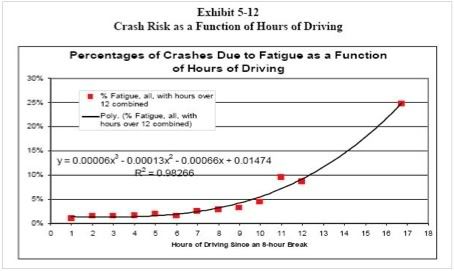
Basically at the 11 hour mark the red dot marks the real crash risk as measured in the study, the black line marks where the agency tried to pretend the risk was. So the "procedural error" was cooking the books to understate the risks that the rule was exposing the public (inclusive of truck drivers) to. Keep in mind the scale of the jumps as well, the risks in the 11th hour doubled. By the way the same court 3 years ago "expressed “very real concerns” about the increase in the daily driving limit from 10 to 11 hours." and commented that the FMCSA's model "understated the risks of driving 11 hours." So this is not about some form that was not filed correctly, this is about a serious safety issue that the court brought to the Agency's attention the last time the rule was struck down which the Agency tried to conceal this time by a dishonest manipulation of the data. This Gonzalesesque obsfucation did not have a discernable purpose other than to justify the unjustifiable. Some of the findings in the ruling were about violated procedures but this was not just about a "procedural error"
U.S. trucking companies want the government to keep regulations allowing truckers to drive 11 hours in a row, rather than the previous limit of 10.
The American Trucking Associations filed a petition Friday with the federal government asking officials to issue a new version of two-year-old regulations on truckers' hours to replace regulations struck down by a court in late July.
The trucking group argued that since the court's late July ruling was focused on procedural issues rather than safety concerns, the Transportation Department should keep similar regulations in place.
The DC Appeals Court ruling (PDF) paints a different picture however:
Public Citizen notes that the TIFA data, upon which FMCSA’s time-on-task multipliers were ultimately based, indicates that “the risk of fatal-crash involvement more than doubled from the 10th hour to the 11th.” Public Citizen Br. 48-
49 (citing 2005 RIA at 45 (J.A. 1665)). The actual time-on-task multiplier for the eleventh hour used in FMCSA’s model, however, was “only 30% higher than the . . . multiplier for the 10th hour.” Id. at 49 (citing 2005 RIA at 61 (J.A. 1681)). Public Citizen contends that the two steps FMCSA used to transform the TIFA data into the time-on-task multipliers were unexplained, and that they had the effect of improperly minimizing the crash risk associated with the 11th hour of driving.
First, as explained above, instead of using the crash risk figures for each hour of driving that the TIFA Study had calculated directly from the actual crash data, FMCSA derived a cubic curve of crash risk as a function of time on task. To derive the curve, FMCSA first plotted the TIFA figures for Hours 1 through 12, and then used an aggregate measure for Hour 13 and beyond. It did not, however, plot the 13+ figure at Hour 13, but rather at Hour 17. See 2005 RIA at 59 (J.A. 1679). As shown in the accompanying graph, the curve that fit those 13 points yielded a crash risk at Hour 11 that was substantially below the figure that the TIFA Study had calculated directly from the actual crash data.
Basically at the 11 hour mark the red dot marks the real crash risk as measured in the study, the black line marks where the agency tried to pretend the risk was. So the "procedural error" was cooking the books to understate the risks that the rule was exposing the public (inclusive of truck drivers) to. Keep in mind the scale of the jumps as well, the risks in the 11th hour doubled. By the way the same court 3 years ago "expressed “very real concerns” about the increase in the daily driving limit from 10 to 11 hours." and commented that the FMCSA's model "understated the risks of driving 11 hours." So this is not about some form that was not filed correctly, this is about a serious safety issue that the court brought to the Agency's attention the last time the rule was struck down which the Agency tried to conceal this time by a dishonest manipulation of the data. This Gonzalesesque obsfucation did not have a discernable purpose other than to justify the unjustifiable. Some of the findings in the ruling were about violated procedures but this was not just about a "procedural error"
Mortgages and the People who write about them
Calculated Risk:MMI: Staying Ignorant in Five Easy Steps
Tanta at Calculated Risk takes apart a Marketwatch fluff piece on how to get a mortgage in a credit crunch. The article and the comments give a much better picture of the realities of the mortgage market than most of the stories pulled off the evergreen pile in the MSM.
The Onion, of course, has something to contribute as well.
Subscribe to:
Posts (Atom)